Business card
Marco Valentinsig. Today social media has become the first tool for a company to make itself known and win over the customer before even making a commercial offer.
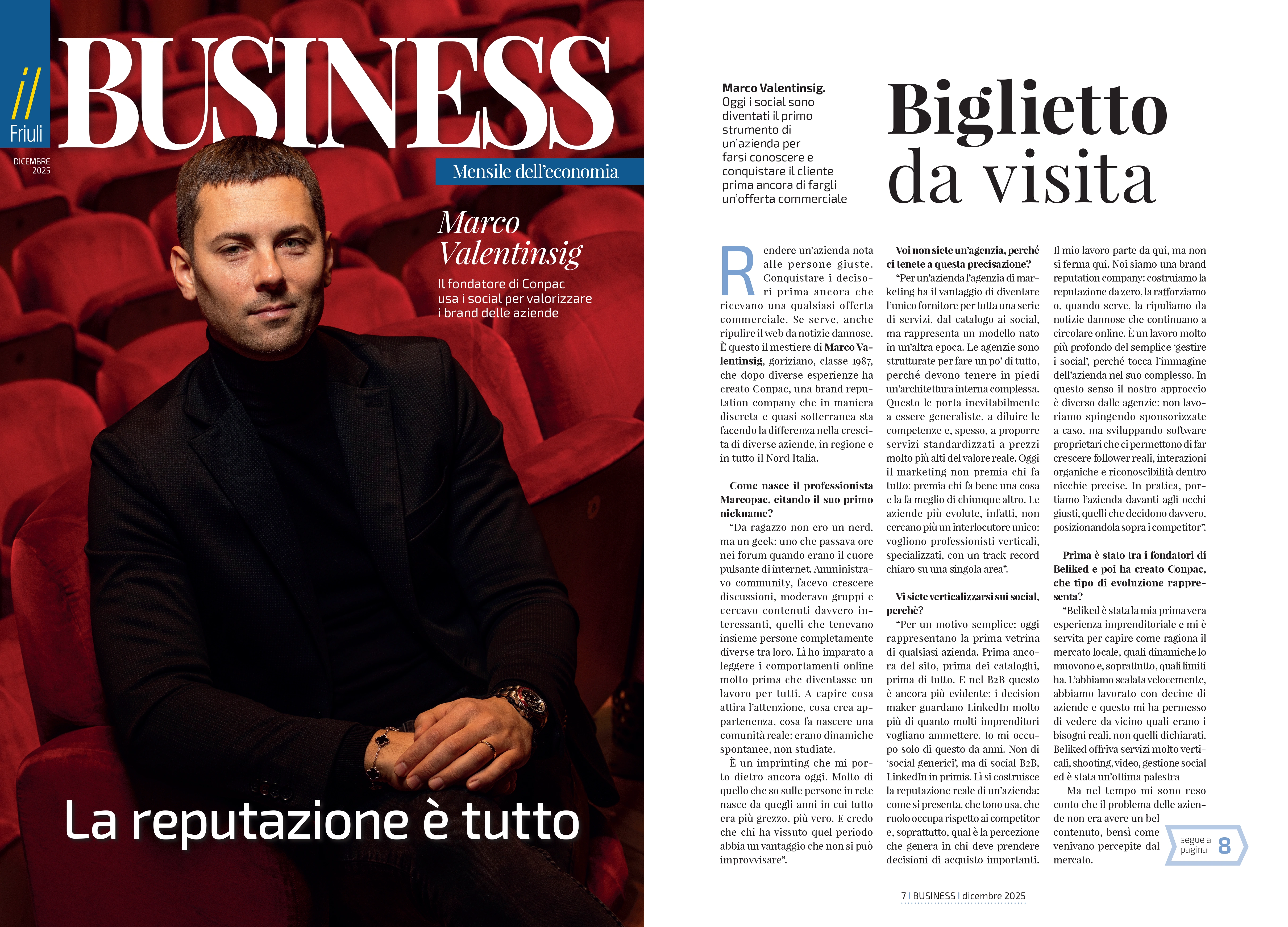
Making a company known to the right people. Win over decision makers before they even receive any commercial offer. If necessary, also clean the web of harmful news. This is the job of Marco Valentinsig, from Gorizia, born in 1987, who after various experiences created Conpac, a brand reputation company which in a discreet and almost underground way is making a difference in the growth of various companies, in the region and throughout Northern Italy.
How was the professional Marcopac born, citing his first nickname?
“As a boy I wasn't a nerd, but a geek: someone who spent hours on forums when they were the beating heart of the internet. I managed communities, grew discussions, moderated groups and looked for really interesting content, the kind that brought together completely different people. There I learned to read online behavior long before it became everyone's job. To understand what attracts attention, what creates belonging, what gives birth to a real community: they were spontaneous, unstudied dynamics.
It's an imprinting that I still carry with me today. Much of what I know about people online comes from those years when everything was rawer, more real. And I believe that those who lived through that period have an advantage that cannot be improvised."
You are not an agency, why do you care about this clarification?
“For a company, the marketing agency has the advantage of becoming the sole supplier for a whole series of services, from the catalog to social media, but it represents a model born in another era. Agencies are structured to do a bit of everything, because they have to maintain a complex internal architecture. This inevitably leads them to be generalists, to dilute skills and, often, to offer standardized services at prices much higher than the real value. Today marketing does not reward those who do everything: it rewards those who do one thing well and do it better than anyone else. In fact, the most advanced companies no longer look for a single interlocutor: they want vertical, specialized professionals with a clear track record in a single area".
You have become vertical on social media, why?
"For a simple reason: today they represent the first showcase of any company. Even before the website, before the catalogues, first of all. And in B2B this is even more evident: decision makers look at LinkedIn much more than many entrepreneurs want to admit. I have only been dealing with this for years. Not with 'generic social networks', but with B2B social networks, LinkedIn first and foremost. That's where the real reputation of a company is built: how it presents itself, what tone it uses, what role does it occupy compared to competitors and, above all, what is the perception it generates in those who have to make important purchasing decisions.
My work starts from here, but doesn't stop here. We are a brand reputation company: we build reputation from scratch, we strengthen it or, when necessary, we clean it of harmful news that continues to circulate online. It is a much deeper job than simply 'managing social media', because it affects the image of the company as a whole. In this sense our approach is different from agencies: we don't work by pushing random sponsorships, but by developing proprietary software that allows us to grow real followers, organic interactions and recognisability within precise niches. In practice, we bring the company before the right eyes, those who really decide, positioning it above its competitors".
First you were among the founders of Beliked and then you created Conpac, what type of evolution does this represent?
"Beliked was my first real entrepreneurial experience and it helped me understand how the local market thinks, what dynamics move it and, above all, what limits it has. We scaled it quickly, we worked with dozens of companies and this allowed me to see up close what the real needs were, not the declared ones. Beliked offered very vertical services, shooting, videos, social management and it was an excellent training ground.
But over time I realized that the problem for companies was not having good content, but rather how they were perceived by the market. From there the evolution began. With Conpac I chose a completely different direction: no longer simple communication, but reputation and positioning. These are the two elements that really determine whether a company is chosen or not. We have worked for years to build proprietary services, developed together with programmers, which today do not exist in any other Italian company. They are not copyable processes, because they do not arise from creativity, but from engineering."
What is 'reputation' for you?
"It's what a company represents in people's minds before they even have direct contact. It's that immediate impression that makes you say: 'this company is reliable', or 'it doesn't convince me'. And it arises from the set of signals that a brand leaves online: the way in which it communicates, the coherence over time, the clarity of the message, the quality of the content, how it responds to customers and also what old remains on the internet. It's very simple: reputation decides everything long before sales."
Why is this so important?
“Because it decides whether you will be searched for, whether you will be taken seriously, whether you will be shortlisted or ignored. It's a very powerful filter: it can open doors or close them before you even knew they existed. And when a reputation is strong, everything else becomes easier: selling, being heard, negotiating, building relationships. For me, reputation is what precedes you. If you don't control it, others will control it."
Your organizational model is also innovative, can you explain it to us?
"In my first entrepreneurial experience I had a physical office, like everyone does. Then, working with structured groups, I understood something very simple: it is always the consultant who goes to the client, never the other way around. The office was more used to 'feel' like a company than to actually carry out the work. When I created my new reality I chose a different model, totally oriented towards digital and people's well-being. We work on a project basis, remotely, with great individual responsibility. Those who have children can manage their own schedules, those who have commitments can take care of them without asking for permission. And paradoxically this increases productivity, not the other way around. Naturally, it cannot be replicated for everyone: those who have invested in factories, machinery and physical production have different needs and I fully respect this."
Let's talk about Friulian companies, what is their approach to your world?
"On average they have a very cautious approach. For many of them, marketing is still a cost, not a strategic investment.
And this produces a paradoxical situation: extraordinary companies, leaders in their sectors and recognized throughout the world, have a digital presence that does not in the slightest reflect the value they express. For years I strongly believed in the territory and worked almost exclusively here. Then I realized something: we talk a lot about innovation, but it is still interpreted as 'new tools'. In reality, true innovation is mental, cultural. The tools come later. Until this step takes place, Friuli will continue to produce excellence that remains invisible.
And it's a shame, because here we know how to work impeccably, but outside the borders it often doesn't emerge how much real value there is behind our businesses".
Is it easy to explain to an entrepreneur or manager what you do?
"The main difficulty does not concern our services: it concerns the cultural context in which these services are perceived. When I talk to them, I often notice a sincere interest in what we do. Our positioning is different from that of traditional agencies and this arouses curiosity. The point, however, is that many structured companies already have a reference agency and, understandably, they trust what they know. The problem arises when the agency does not have the tools or the competence to explain what we really do. And this happens more often than you think: unfortunately the average level of the market, especially in more conservative areas, is quite low. As a result, the entrepreneur does not refuse the service: he simply cannot understand it because no one trustworthy can explain it to him. Our real competitor, in fact, is not the other companies in the sector: this is a sign that when there is professional awareness, collaboration it arises spontaneously. Here in Friuli, however, there is still a strong familiarity with 'old-fashioned' communication: gadgets, calendars, diaries, materials from the Nineties which have an affective, but not strategic, value. It is a reassuring model, but it is no longer competitive".
Is it just a problem of the interlocutor's age?
"No, it's not a problem of age. On the contrary: I often speak with entrepreneurs and board members who are over sixty and who understand perfectly what we do. They have children who live on social media, follow the dynamics of digital and immediately perceive how decisive the issue of reputation has become. What I notice, however, is a difference in mentality. There are very young entrepreneurs who consider marketing an accessory and other more mature ones who see it as a strategic tool. Age has no impact how much you think, the ability to look ahead counts more."
Have you also collaborated with big Friulian names?
"I have been lucky enough to work with many of the main players in the area: Eurotech, Danieli Automation, Fantoni, Calligaris. With some of them we have built communities practically from scratch, transforming inactive profiles into platforms capable of generating attention, credibility and constant interactions on the part of professionals in the sector. An emblematic case is precisely that of the Abs steelworks, where we contributed to significantly expanding their digital community, bringing it into dialogue with a much broader and more international audience than back to the starting point."
And from outside the region?
"Today we are contacted by companies from all over Italy, often very structured groups: we collaborate for example with the Alimac group, with LoJack, with Laticrete. We range from the chemical industry to building materials, from industrial production to technology. We also work with foreign marketing teams, who ask us to improve the quality of interactions and the perception of their brands on professional social networks. And this leads us to collaborate with very different realities: from companies with ten million euros in turnover up to groups that well exceed one billion. The results vary from sector to sector, but the common thread is always the same: to bring out in the digital world the solidity of realities that are already enormous in real life, but which often do not fully reflect their value online. And when this gap closes, the changes can be seen immediately".
Does an interview in a paper newspaper like the one I'm doing with you still make sense?
"Paper still has a meaning for those who attribute a symbolic value to it: leafing through, preserving, cutting out. It is a form of communication that belongs to a certain imagination and for some people it remains important. But if we talk about strategic value, today data counts. And unfortunately paper does not produce any. It is a communication that leaves sensations, not information. Today, value is not only given by what is communicated, but by what can be measured".
Appearing right
Social yes, but in moderation and above all in a targeted manner. This is the recommendation that Marco Valentinsig gives to normal navigators, especially those a few years older.
How many personal social profiles do you have?
“I am only present on two platforms: Instagram and LinkedIn. I don't live on personal visibility, but I really believe in the value of personal branding especially for those who lead a company. People, by nature, follow other people. Customers, suppliers, partners: everyone trusts a face, an opinion, a clear position expressed by an individual more easily than an anonymous institutional communication. This is why I believe that every CEO should expose themselves more, tell their vision, share skills and points of view".
Do you also publish photos of kittens, of your dinner or of you beached like a cetacean?
“I carefully avoid it: I would probably lose market share within a week. I only use social media for work. In the past, I also shared my personal life, but I realised that exposing myself that way creates unpleasant dynamics that are largely irrelevant to what I do. Today, my online presence is much more selective: I talk about where we are going, who we work with, the projects we are developing and the results we deliver. My audience mainly consists of business owners, marketing managers and industry professionals. People looking for useful content, not entertainment. In my work, the point is not to be more visible, but to present myself better. That calls for selectivity, not overexposure.”
At what age would you give your child a smartphone?
"I don't think the right question is 'at what age', because technology is never a problem in itself: the problem is how you use it. I see people in their sixties who spend hours scrolling endlessly watching senseless videos, without any critical filter. And at the same time I know 10-year-olds who use smartphones to build small apps, learn to program or delve into topics that adults ignore. This shows that age is not a reliable indicator."
What is your favorite activity offline, i.e. in real life?
"I read a lot. It is my favorite activity and probably the one that keeps me in balance. I especially delve into topics related to neuromarketing, people's behavior and the mechanisms that guide choices, everything that, directly or indirectly, influences the perception of brands. It is a curiosity that I have always carried with me, I don't live it as a hobby but as a way of really understanding how we work. Alongside this is a second routine that I care a lot about: I train every At 6.30 I'm already in the gym. I like the idea of training my mind but also my body, of maintaining discipline and clarity on both fronts.
Do you have a next goal?
"After three years of work, my first book is about to be released: Reputation Marketing. For me it is a great personal satisfaction. It is a project that encompasses everything I have learned by observing and working with very different companies".
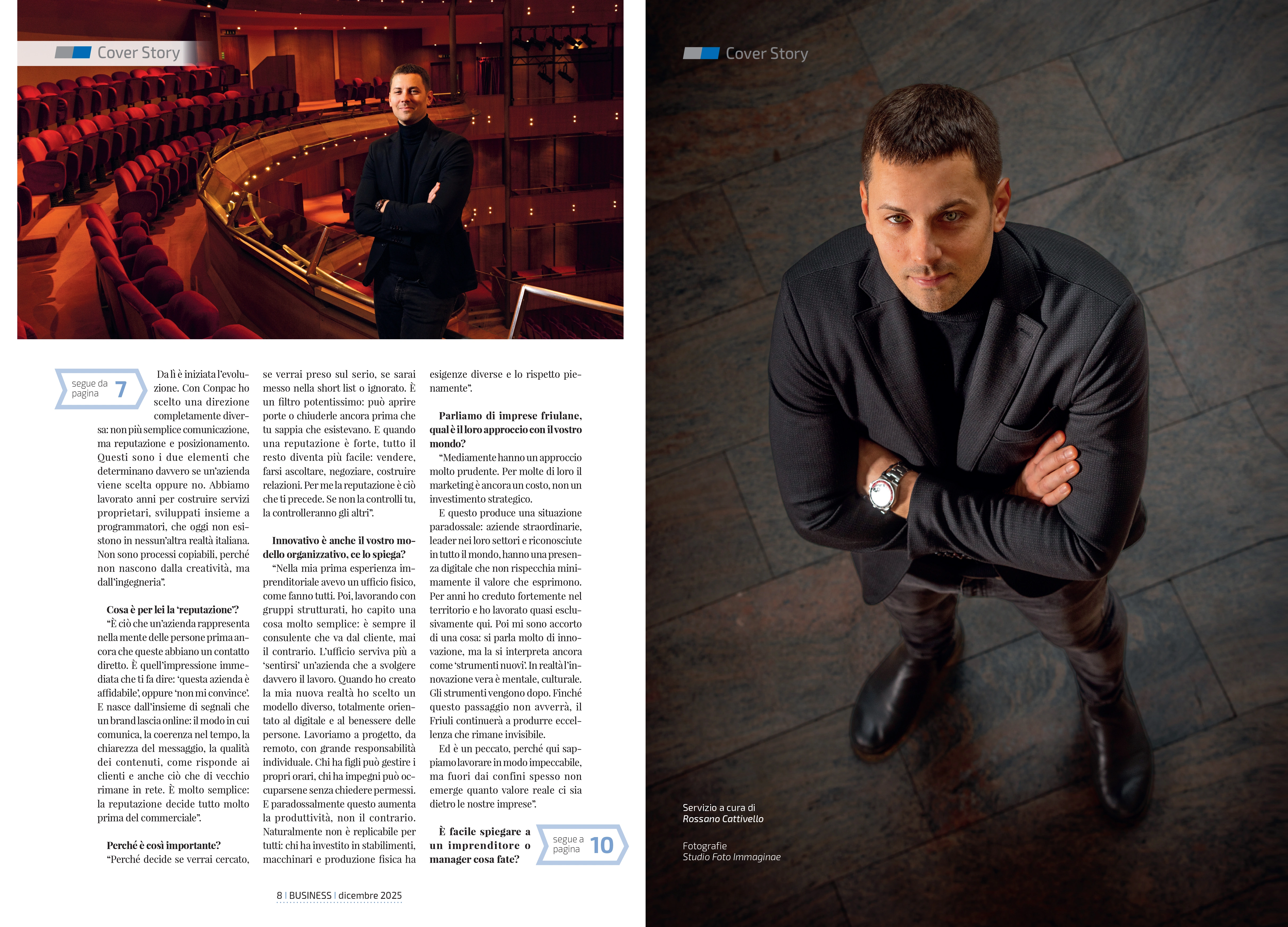
Service by Rossano Cattivillo. Photographs: Studio Immagine. Friuli Business, December 2025.