

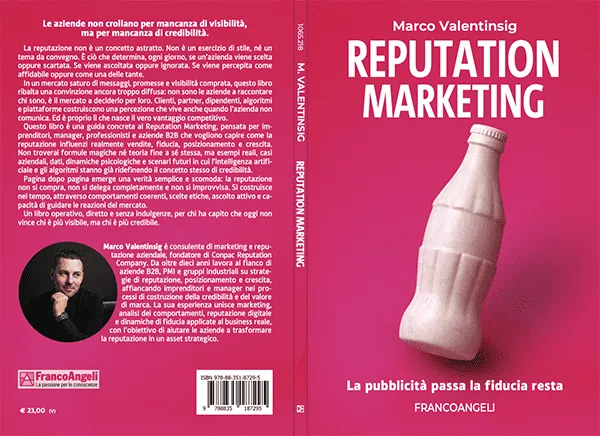
The digital reputation for companies does not only concern the image transmitted online. It is a heritage built over time through contents, behaviors, relationships and signals that influence the way in which customers, partners and stakeholders evaluate a company. Nordest24 dedicated an article to the book by Marco Valentinsig, founder of CONPAC, presenting it as a text aimed at those who want to understand the role of reputation in B2B marketing and transform it into a concrete tool for growth. The volume collects experiences gained in the field, reflections, company cases and recurring errors observed during over ten years of work in digital communication. The starting point is simple: a company is not only evaluated for what it produces, but also for what the market perceives.
Digital reputation for companies: beyond the simple image
Talk about digital reputation for companies does not mean dealing exclusively with the aesthetic aspect of a site, a LinkedIn page or a social profile. Reputation arises from the consistency between what the company declares, what it demonstrates and what people recognize. A company can have excellent products, advanced processes and solid technical skills, but if it appears poorly present, unclear or not authoritative online, it risks being perceived as lower than its real value. This gap between constructed value and perceived value represents one of the most frequent problems in the B2B world. The book addresses precisely this distance, showing how contents, digital presence and communication can contribute to making it smaller.
Reputation as a strategic asset
Reputation is not a secondary consequence of marketing activities. It is a strategic asset that can impact trust, the ability to attract opportunities and the position occupied by the company in its market. Before choosing a supplier, starting a collaboration or responding to a business proposal, people look for information. They observe the website, social media, the people who represent the company and the way in which skills and results are communicated. Each element contributes to forming a judgment. For this reason, reputation must be managed continuously. It cannot depend on an isolated campaign or a few pieces of content published occasionally.
From field work to an applicable method
One of the central aspects of the editorial project is the link with real experience. The book is not only born from theoretical reflections, but from the work carried out with companies, industrial groups and B2B entities that have faced concrete problems of positioning, recognisability and communication. These experiences have made it possible to identify some recurring mistakes: talking only about products, communicating in a too technical way, publishing without direction, interrupting activities when they do not produce immediate results or entrusting reputation to disconnected initiatives. Transforming experience into method means offering companies a perspective applicable to daily decisions.
Building a B2B competitive advantage
In the business to business market, the difference between similar companies is not always determined exclusively by the price or the characteristics of the offer. Trust often comes into play. A company perceived as authoritative, present and reliable starts from a different position than a competitor that communicates little or is unable to make its skills recognisable. Reputation can therefore become a B2B competitive advantage, because it facilitates the recognition of corporate value even before the commercial relationship begins. It does not replace the quality of the product or service. It makes it more visible and easier to understand.
CONPAC's point of view
For CONPAC, reputation cannot be invented through communication. It must start from real elements: skills, people, processes, results, corporate culture and the ability to deliver what is promised. The role of marketing is to make these elements readable and recognisable. This means building coherent content, monitoring the relevant channels, analyzing the signals produced and maintaining continuity over time. The value of communication is not measured only by the number of views obtained, but by the ability to positively change the perception of the company.
A read for companies and marketing professionals
The book is aimed at entrepreneurs, marketing managers, professionals and people involved in the communication of B2B companies. It does not propose shortcuts to obtain immediate visibility, but invites us to consider reputation as a progressive path. In a market where many companies present similar offers, becoming recognizable requires method, consistency and a long-term vision. The digital reputation for companies thus becomes a discipline that connects marketing, positioning, content and trust.
Why we chose to share this article
The section “In the press"collects the publications that tell about CONPAC, the work of Marco Valentinsig and our vision of corporate communication. The Nordest24 article is significant because it highlights one of the main objectives of the book: to help companies understand that reputation is not an abstract concept, but an element capable of concretely influencing growth, positioning and competitiveness. For us, reputation is what allows the real value of a company to be recognized even externally.
Read the original article
➡️ Read the full article on Nordest24 newspaper.