
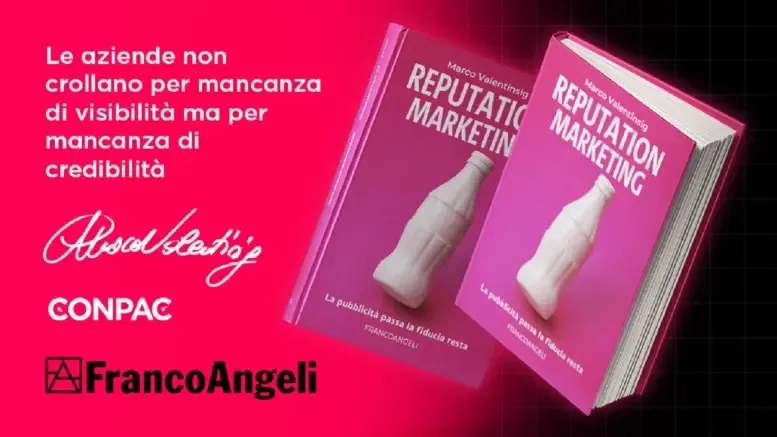
The digital word of mouth has transformed the way customers, partners and stakeholders know and evaluate a company. Today it is no longer enough to work well and wait for the market to spontaneously recognize the value built over time. Reviews, content, social media, search results and online presence contribute to forming an opinion even before starting a direct relationship with the company. In this context, Friuli Today dedicated an article to Reputation Marketing, the book by Marco Valentinsig, founder of CONPAC, published to explore the role of reputation in contemporary business strategies. The central theme of the article is particularly close to the economic fabric of Friuli Venezia Giulia: many solid companies continue to rely above all on traditional commercial models, while customer behavior has already changed.
From traditional word of mouth to digital word of mouth
For years many companies have built their growth through personal relationships, satisfied customers and knowledge gained in the area. This mechanism has not disappeared, but has transformed. The digital word of mouth occurs through reviews, comments, shared content, social profiles, articles, search engines and online conversations. People continue to trust the experiences of others, but today they look for them and find them on the web. For a company, this means that its reputation no longer depends only on what happens in direct relationships. It also depends on the information accessible online, the quality of communication and the ability to build a consistent presence over time.
The limit of "we've always done it this way"
One of the clearest themes recalled in the article concerns resistance to change. In the entrepreneurial fabric of Friuli Venezia Giulia there are companies with high skills, competitive products and an important history. However, some continue to communicate and look for customers according to logics that belong to a market different from the current one. Relying solely on reputation built offline can become a limitation when customers, candidates and partners begin each evaluation through an online search. The problem is not that traditional methods no longer have any value. The problem arises when they are considered sufficient. Today the market observes, compares and decides also on the basis of digital perception.
Business reputation and perceived value
The business reputation arises from the relationship between what a company really is and what the market can perceive. A company can be reliable, competent and structured, but appear unrecognizable if it does not communicate continuously. It may have satisfied customers, but not value their experiences. He may possess important technical knowledge, but not transform it into content capable of strengthening his authority. In these cases, the real value of the company remains partially invisible. Reputation work serves to reduce this distance. It doesn't mean inventing non-existent qualities, but making those already present in the company more legible.
Real cases, not just theory
Reputation Marketing was born from the experience gained by Marco Valentinsig working directly with companies and organizations belonging to different sectors. The book starts from problems observed in the field: valid businesses that struggle to emerge, discontinuous communication, dependence on traditional word of mouth, overly technical content and difficulty in building a recognizable presence. These cases show that reputation is not an abstract issue or exclusively linked to large companies. It also concerns local businesses, industrial entities and B2B organizations that must compete in increasingly informed and transparent markets.
Being reliable is not enough if no one perceives it
One of the principles underlying the book is that real quality remains indispensable, but does not in itself guarantee market recognition. Today, the company that has been present the longest is not necessarily chosen. The one that is perceived as more reliable, authoritative and coherent is often chosen. Reputation contributes to this perception. An updated website, useful content, a constant social presence, credible reviews and clear communication can strengthen the value of the company even before the first commercial contact. The digital word of mouth thus becomes a concrete component of the choice process.
CONPAC's point of view
For CONPAC, reputation cannot be built through artificial messages or unsupported promises. It must start from the reality of the company: products, people, processes, skills, results and organizational culture. The task of communication is to make these elements visible and understandable. This requires continuity, method and ability to observe how the market interprets the signals produced by the company. Reputation does not arise from a single piece of content. It is the result of the sum of all the experiences and information associated with the brand.
Why we chose to share this article
The section “In the press"collects the publications that describe CONPAC, the work of Marco Valentinsig and our vision of corporate reputation. The article by Friuli Today is significant because it connects the book to a concrete problem in the area: the need to overcome consolidated models that no longer reflect the current behavior of the market. For us, building reputation means helping companies not to depend exclusively on what the market already knows, but to become recognizable even in the eyes of those who have not yet met them.
Read the original article
➡️ Read the full article on the newspaper Friuli Today.