
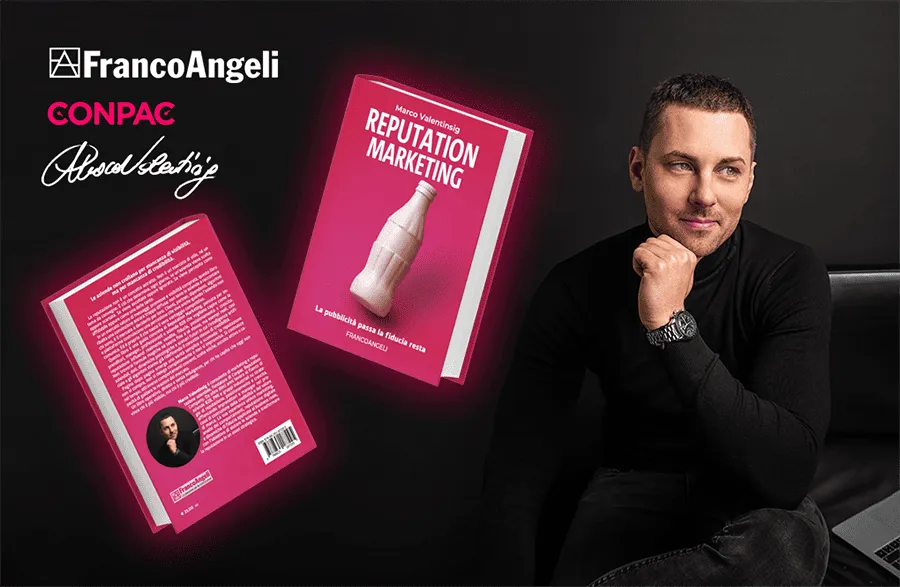
Building corporate reputation means working over time on trust, credibility and the ability of a company to be recognized for its real value. It is not the result of a single campaign, successful content or increased advertising exposure. It is a process that involves behaviour, communication, digital presence, relationships and coherence between what the company promises and what it demonstrates. In this context, Italia Economy dedicated an article to Reputation Marketing, the book by Marco Valentinsig, founder of CONPAC, presenting it as a guide aimed at companies and professionals who want to understand how to transform reputation into a concrete lever for growth. The central point of the article is clear: advertising can generate attention, but it is trust that determines long-term value.
Build corporate reputation methodically
Per build corporate reputation it is not enough to increase visibility. Being known does not necessarily mean being trusted. A company can often appear online, invest in campaigns and publish a lot of content without managing to generate a truly positive perception. Reputation is born when the market recognizes consistency, competence, solidity and continuity. For this reason it must be treated as a strategic project. It is necessary to understand which signals the company communicates, how they are interpreted, which elements strengthen trust and which risk weakening it. The book starts precisely from this distinction between notoriety and reputation: two concepts that are often confused, but very different in the effects they produce.
From advertising to trust
One of the underlying principles of Reputation Marketing is summarized in the idea that advertising passes, while trust remains. Advertising communication can help a company to make itself known, present a product or reach a wider audience. However, it alone does not guarantee credibility. Trust is built through the overall experience associated with the brand. What matters is the quality of the content, the presence on digital channels, the behavior of the people who represent the company, the way in which interactions are managed and the ability to keep promises over time. From this perspective, reputation does not replace advertising. It gives it greater strength and credibility.
Real cases and practical application
The article by Italia Economy highlights one of the most concrete aspects of the book: the presence of real case studies. Reputation is often told through abstract concepts, general principles and definitions that are difficult to translate into operational actions. The volume instead adopts an approach linked to field experience. Business cases allow us to observe how reputation is built, managed and strengthened over time, but also which errors can compromise it. This makes the book useful not only for those who work in marketing, but also for entrepreneurs and managers who have to make decisions about communication, positioning and perception of their company.
Reputation marketing strategies
Le reputation marketing strategies start from a fundamental question: what idea does the market form when it meets the company? The answer does not depend on just one element. The website, search engine results, social media, reviews, articles, published content, management behavior and the quality of relationships with customers, collaborators and stakeholders come into play. Each touchpoint contributes to the overall reputation. This is why a reputational strategy cannot be fragmented. It must connect communication, corporate identity, digital presence and organizational behavior. Marketing thus becomes a tool for making the value of the company visible and comprehensible, not for artificially building an image without evidence.
Reputation as a driver of growth
A solid reputation can impact various aspects of corporate life. It can increase customer trust, reduce the distance before a negotiation, strengthen positioning, make commercial messages more credible and help the company attract collaborators, partners and new opportunities. In B2B this process is particularly important. Decisions are often complex, involve multiple people and take longer. Before choosing a supplier, the market observes, compares and seeks confirmation. In this scenario, reputation becomes an accelerator of trust. It does not automatically guarantee the sale, but creates more favorable conditions for the value of the company to be recognized.
The role of data
Another central aspect concerns the use of data. Reputation cannot be managed solely through personal impressions or subjective evaluations. It is necessary to observe concrete signals: quality of interactions, perception of content, trend of digital presence, public responses and consistency between objectives and results. Data alone does not tell the entire reputation of a company, but it helps to understand where to intervene. They allow us to distinguish purely quantitative metrics from signals that indicate trust, authority and real interest. For CONPAC, this distinction is essential: not all numbers have the same value and not all visibility produces reputation.
CONPAC's point of view
For CONPAC, reputation cannot be fully purchased, delegated, or artificially accelerated. It can be designed and managed, but it must always start from the reality of the company. Products, people, processes, skills, culture and behaviors represent the foundations. Communication has the task of making these elements visible, coherent and recognisable. Le reputation marketing strategies therefore serve to reduce the distance between what the company is and what the market perceives. When this distance decreases, communication becomes more credible and business value easier to recognize.
Why we chose to share this article
The section “In the press"collects the publications that describe CONPAC, the work of Marco Valentinsig and our vision of corporate reputation. The article by Italia Economy is significant because it puts the method at the center: building reputation through data, real cases, continuity and strategic choices. For us, reputation is not a one-time achievement. It is a heritage that must be built, observed and strengthened over time, so that the real value of a company is also recognized by the market.
Read the original article
➡️ Read the full article on the newspaper of Italia Economy.