
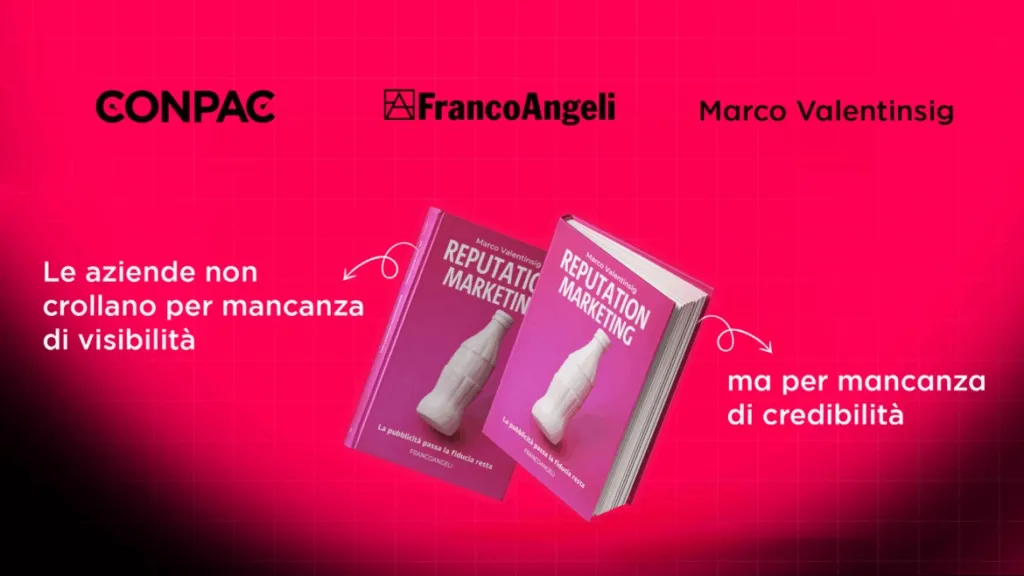
Overcoming conventional marketing means questioning the idea that to build value it is enough to increase visibility, publish more content or invest more in advertising. The current market is saturated with messages, promises and purchased communication. In this scenario, being present does not automatically mean being credible and reaching many people does not guarantee that a company will be considered trustworthy. In this context, Il Friuli dedicated an article to Reputation Marketing, the book by Marco Valentinsig, founder of CONPAC, presenting it as an editorial project capable of challenging some beliefs that are still widespread in corporate marketing. The underlying principle is simple: visibility can attract attention, but it is reputation that influences the way a company is listened to, evaluated and chosen.
Why overcome conventional marketing
Per overcome conventional marketing we must start from a fundamental distinction: communicating does not necessarily mean building trust. A company can publish continuously, invest in campaigns and increase its exposure without being able to truly strengthen the perception of the brand. This happens when communication is treated as a set of separate activities, rather than as part of a larger reputational process. Content, advertising, social media and relationships must contribute to building a coherent image of the company. Otherwise, visibility risks remaining superficial and not producing lasting effects.
The limit of standardized communication
One of the most frequent problems of traditional marketing is the tendency to replicate similar formulas. Editorial plans constructed in the same way, interchangeable contents, generic messages and campaigns oriented above all to frequency can make a company present, but not necessarily recognisable. When everyone communicates with the same codes, it becomes difficult to stand out. The point is not to find a more creative formula than the others. It's about building a more credible perception. This requires consistency between what the company says, what it demonstrates and what the market can actually recognise.
Reputation-based marketing
The reputation-based marketing starts from a different logic than simple promotion. It doesn't just ask how to reach more people, but what ideas those people will form after encountering the brand. Every point of contact contributes to this perception: the site, social media, articles, published content, the people who represent the company, the reviews and the company's behavior in ordinary moments and in critical situations. Reputation arises from the sum of all these signals. For this reason it cannot be built through a single campaign. It requires continuity, method and a vision capable of connecting communication, corporate identity and behaviour.
From visibility to credibility
One of the central messages of Reputation Marketing is that today the most visible company does not necessarily win. The one perceived as most credible is often chosen. Visibility can be bought, accelerated and measured through impressions, reach and views. Credibility, however, takes time. It arises from coherence, the quality of relationships, the ability to keep promises and the way in which the market interprets the company's behaviour. This does not mean that advertising and visibility are not needed. It means that they must rest on solid reputational foundations. Without credibility, attention is likely to be short. With a strong reputation, commercial communication also becomes more effective.
A concrete and applicable approach
The book does not propose magic formulas or an abstract theory of marketing. It starts from real examples, business cases, data and dynamics observed by working directly with B2B companies, SMEs and industrial groups. The goal is to show how reputation can influence trust, positioning, sales and growth. This approach makes the topic useful not only for those who work in communication, but also for entrepreneurs and managers called upon to decide how to present the company, what signals to build and how to make its value more recognisable.
CONPAC's point of view
For CONPAC, marketing should not serve to build an artificial image. It should help the market better understand the real value of the company. Products, skills, people, processes, culture and results are the foundation of reputation. Communication has the task of making them visible, understandable and coherent. The reputation-based marketing therefore works on the distance between real value and perceived value. When this distance decreases, the company is more easily recognized for what it can do and for the reliability it can demonstrate.
A criticism of superficial marketing
Challenging conventional marketing does not mean rejecting every traditional tool. It means rejecting the idea that using those tools is enough to produce value. Social media, advertising, content and campaigns remain useful, but must be placed in a strategic direction. When this direction is missing, communication risks becoming noise: many activities, many messages, but little recognisability. The book therefore invites us to bring attention back to the substance: credibility, trust, coherence and ability to build a distinctive position in the market over time.
Why we chose to share this article
The section “In the press” collects the publications that tell about CONPAC, the work of Marco Valentinsig and our vision of corporate reputation. The article of Il Friuli is significant because it focuses on a specific theme: the need to overcome a way of doing marketing based above all on presence, frequency and visibility. For us, marketing becomes truly strategic when it helps a company to be perceived as credible, authoritative and coherent. Not when he communicates more than others, but when he manages to build a reputation capable of making the market choice natural.
Read the original article
➡️ Read the full article on the newspaper Il Friuli.